













Le gazon artificiel peut transformer une cour, un jardin, une aire de jeux, un toit-terrasse ou un espace commercial en un espace propre, vert et nécessitant peu d'entretien. Cependant, la plupart des plaintes concernant le gazon artificiel ne sont pas dues au gazon lui-même. La plupart des problèmes proviennent de… erreurs d'installation, notamment la préparation des fondations, la conception du drainage, les travaux de jointoiement et la fixation des bords.
Ce guide explique les plus courants problèmes d'installation de gazon artificiel, Cet article explique les causes des problèmes de pelouse synthétique et comment les prévenir. Que vous fassiez appel à un installateur ou que vous réalisiez les travaux vous-même, cet article vous aidera à éviter des réparations coûteuses et à profiter d'une pelouse synthétique durable.
Table des matières
- Pourquoi une installation correcte du gazon artificiel est importante
- Erreur #1 : Choisir le mauvais type de gazon artificiel
- Erreur #2 : Mauvaise préparation du sol (Cause de défaillance du gazon : #1)
- Erreur #3 : Mauvaise conception du drainage (flaques d’eau, cloques, odeurs)
- Erreur #4 : Rides, ondulations et mouvements du gazon
- Erreur #5 : Coutures visibles (différence de couleur, lignes, espaces)
- Erreur #6 : Sécurisation périmétrique inadéquate (bords soulevés, risques de trébuchement)
- Erreur #7 : Omettre ou mal positionner la barrière anti-mauvaises herbes
- Erreur #8 : Remplissage incorrect ou insuffisant
- Erreur #9 : Négliger la dilatation et la contraction
- Erreur #10 : Installation sans outils et équipements appropriés
- Signes d'alerte lors du choix d'un installateur de gazon artificiel
- Liste de vérification pour l'installation de gazon artificiel (Résumé rapide)
- FAQ : Problèmes et erreurs lors de la pose de gazon artificiel
- 1) Quelle est l'erreur la plus courante lors de l'installation de gazon artificiel ?
- 2) Comment savoir si le problème vient de l'installation ou de la qualité du gazon ?
- 3) Pourquoi mon gazon artificiel a-t-il des couleurs différentes à différents endroits ?
- 4) Combien de temps le gazon doit-il reposer avant d'être installé ?
- 5) Peut-on installer du gazon artificiel directement sur la terre ou sur du gazon naturel existant ?
- 6) Pourquoi y a-t-il des flaques d'eau sur le gazon artificiel après la pluie ?
- 7) Dois-je installer une barrière anti-mauvaises herbes sous le gazon artificiel ?
- 8) Pourquoi mes coutures sont-elles visibles même lorsque le gazon est neuf ?
- 9) Qu'est-ce qui provoque la séparation des coutures au fil du temps ?
- 10) Un remplissage est-il toujours nécessaire ?
- 11) Quel matériau de remplissage faut-il éviter pour le gazon synthétique pour animaux de compagnie ?
- 12) Peut-on installer du gazon artificiel sur du béton ?
- 13) Peut-on corriger les rides sans tout réinstaller ?
- 14) Comment éviter que le gazon artificiel ne sente mauvais ?
- 15) Que dois-je vérifier avant de payer l'installateur ?
- En conclusion : mieux vaut prévenir que guérir.
Pourquoi une installation correcte du gazon artificiel est importante
Le gazon synthétique est un investissement à long terme. De nombreux produits sont assortis de garanties (souvent). 8 à 15 ans, La garantie peut varier selon le type de produit et le fournisseur, mais elle est généralement conditionnée par une installation correcte. Une mauvaise installation peut réduire la durée de vie du gazon synthétique, diminuer le confort, créer des risques pour la sécurité et engendrer des travaux de réparation coûteux.
L'installation par un professionnel peut coûter plus cher au départ, mais elle permet souvent de réaliser des économies à long terme en évitant des problèmes tels que les plis, l'affaissement et la séparation des joints.
Erreur #1 : Choisir le mauvais type de gazon artificiel
Tous les gazons artificiels ne sont pas conçus pour le même usage. Les différents produits présentent des hauteurs de brins, des formes de fils, des densités, des textures et des structures de support différentes.
Erreurs courantes de sélection de gazon
Utilisation de gazon synthétique pour les terrains de sport à fort trafic
Installation de gazon synthétique pour putting green dans un jardin résidentiel (souvent trop dense et rigide)
Choisir un gazon synthétique pour animaux sans prévoir le drainage et l'accès pour le nettoyage
Utilisation de gazon décoratif à faible densité pour les aires de jeux
Comment l'éviter
Avant d'acheter, définissez comment l'espace sera utilisé.
Est-ce que des enfants vont jouer dessus ?
Les animaux domestiques l'utiliseront-ils quotidiennement ?
Y aura-t-il un fort passage piétonnier ?
Est-ce purement décoratif ?
Les fabricants de qualité proposent des produits adaptés à l'aménagement paysager, aux terrains de sport, aux espaces pour animaux et aux greens de golf. Demandez toujours des échantillons et vérifiez la souplesse, la résilience, la résistance du support, la présence de trous de drainage et la densité globale.
Erreur #2 : Mauvaise préparation du sol (Cause de défaillance du gazon : #1)
La base est essentielle à la bonne tenue de votre gazon artificiel. Si la base est inadéquate, le gazon ne se développera pas correctement, quelle que soit la qualité du produit.
Problèmes causés par des travaux de fondation de mauvaise qualité
Surfaces irrégulières avec bosses, creux et vagues
Accumulation d'eau et défaillances du drainage
Déplacement et plissement du gazon
Usure prématurée aux endroits les plus exposés
Dolines causées par la décomposition de matières organiques
À quoi ressemble une bonne préparation de base
Une base stable nécessite une excavation correcte, des matériaux propres et un compactage par couches successives.
Étape 1 : Enlever toute la matière organique
Toute la végétation (herbe, mauvaises herbes, racines et débris) doit être enlevée. Les souches et les mottes de racines doivent être complètement broyées. La décomposition des matières organiques crée des vides, ce qui peut entraîner des affaissements et des rides par la suite.
Étape 2 : Installer une base en agrégats compactés
Une norme résidentielle courante est 75–100 mm de pierre concassée compactée ou de fondation routière. Une fondation plus épaisse peut être nécessaire pour les sols meubles, les régions à fortes précipitations ou pour un usage commercial.
Étape 3 : Ajouter une fine couche de nivellement
Une fine couche de nivellement, comme du granit décomposé ou de la pierre concassée fine, améliore la régularité et facilite le nivellement final.
Étape 4 : Compacter en couches
Le compactage doit être effectué en plusieurs étapes et par couches successives. L'utilisation d'une plaque vibrante est indispensable et ne doit pas être négligée.
Signes avant-coureurs de travaux de fondation de mauvaise qualité
La profondeur de la base est trop faible.
L'installateur pose le gazon synthétique sur la terre ou le gazon existant.
Aucun équipement de compactage n'est utilisé
La base contient des matières organiques ou instables
La surface finale est plane et sans pente de drainage.
Erreur #3 : Mauvaise conception du drainage (flaques d’eau, cloques, odeurs)
Le gazon artificiel n'absorbe pas l'eau comme le gazon naturel. L'eau doit s'écouler à travers le gazon et être évacuée par la base et le système de drainage du site.
Signes de défaillance du drainage
Eau stagnante après la pluie
Endroits détrempés ou spongieux
Bulles d'eau ou cloques sous le gazon
Mousse, algues ou moisissures
Odeurs désagréables dues à l'humidité emprisonnée
Comment construire un système de drainage efficace
Intégrer une pente dans la base
UN Pente 1–2% Il est généralement recommandé de diriger l'eau loin des bâtiments.
Utiliser des matériaux de base propres et perméables
Les problèmes de drainage surviennent souvent parce que le sol contient de l'argile, trop de particules fines ou des matériaux instables.
Améliorer le drainage dans les sites difficiles
Dans les sols argileux ou les régions à fortes précipitations, un drainage supplémentaire peut être nécessaire, par exemple :
Drains français (tuyau perforé + gravier)
Canaux de drainage ou caniveaux de drainage
Couches de cellules de drainage
Renforcement par géocellules des sols meubles
Note particulière pour les installations en béton
On peut installer du gazon synthétique sur du béton, mais il est indispensable de prévoir un système de drainage. Le béton doit présenter une pente et l'eau doit pouvoir s'écouler sur les bords. Une erreur fréquente consiste à coller le gazon sur une dalle de béton plate sans espace de drainage, ce qui retient l'eau et provoque des odeurs.
Erreur #4 : Rides, ondulations et mouvements du gazon
Les rides apparaissent généralement en raison d'une préparation de base irrégulière, d'une fixation insuffisante ou de la dilatation et de la contraction thermiques du gazon. Les causes courantes incluent :
Gazon non acclimaté avant la pose
Le gazon était tendu à l'extrême.
Points mous ou faible compactage de la base
Fixation du périmètre insuffisante
adhérence des coutures faible
Si vous souhaitez en savoir plus sur Pourquoi le gazon artificiel se plisse-t-il et comment y remédier ?, consultez notre guide détaillé sur rides du gazon artificiel.
Prévention
Le gazon synthétique doit être déroulé et laissé se détendre avant d'être coupé et fixé. Il doit être solidement fixé, sans être trop tendu. Des joints de dilatation doivent être prévus près des surfaces rigides, comme les murs.
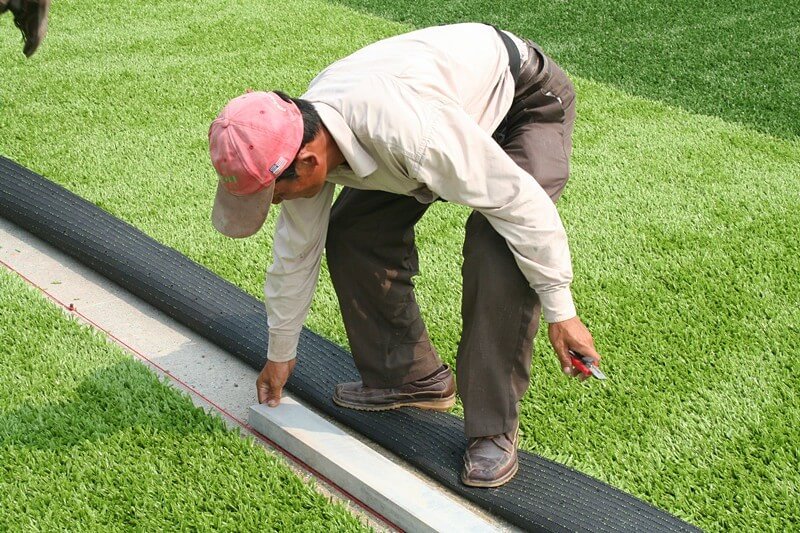
Erreur #5 : Coutures visibles (différence de couleur, lignes, espaces)
Les coutures sont les points de rencontre de deux rouleaux de gazon. Des coutures mal réalisées nuisent à l'esthétique et peuvent créer des points faibles.
Signes de coutures mal réalisées
Lignes de couture visibles
Chaque côté présente une couleur différente.
Espaces entre les pièces
Les chevauchements créent des crêtes surélevées
Les coutures se séparent avec le temps
Installation correcte des coutures
Assurez-vous que le sens du pilon corresponde sur les deux rouleaux.
Éliminez soigneusement les bords de fabrication.
Bords serrés avec un minimum de support visible
Utilisez du ruban d'étanchéité centré sous le joint.
Appliquez l'adhésif approprié et laissez sécher correctement.
Évitez de piéger les brins d'herbe dans la colle.
Utiliser des poids pendant le durcissement pour une adhérence solide.
Conseil important concernant la “ différence de couleur ”
La couleur du gazon artificiel varie souvent en fonction du sens des fibres. Si un rouleau est installé dans le sens inverse, il aura l'air différent, même s'il s'agit du même produit.
Erreur #6 : Sécurisation périmétrique inadéquate (bords soulevés, risques de trébuchement)
Les bords doivent être solidement fixés afin d'éviter tout soulèvement, déplacement et tout risque pour la sécurité.
Problèmes causés par un mauvais travail des bords
bords frisés
Mouvement du gazon sous les pieds
Lacunes aux frontières
Intrusion de mauvaises herbes en bordure
dangers de trébuchement
Meilleures pratiques
Les fixations sont généralement installées tous les 100–300 mm Sur le périmètre, un espacement plus serré est nécessaire. Les angles, les courbes et les zones à fort passage exigent des fixations plus serrées. Il est recommandé d'utiliser des fixations galvanisées pour limiter la corrosion.
Les bords doivent être fixés à :
bandes de fixation en bois
béton ou pavés
Piquets souterrains dans les paysages meubles
Dispositifs de bordure appropriés
Erreur #7 : Omettre ou mal positionner la barrière anti-mauvaises herbes
Une toile de paillage n'est pas un simple “ extra ”. Elle empêche les mauvaises herbes de pousser sur les bordures et réduit l'entretien.
Pourquoi les mauvaises herbes continuent-elles de pousser dans le gazon ?
Les mauvaises herbes peuvent pénétrer par les zones périphériques ou par le biais de graines emportées par le vent qui se déposent dans les matériaux de remplissage.
Méthode correcte
Une barrière géotextile de qualité contre les mauvaises herbes (souvent autour de 100–125 g/m²) doit être installé correctement.
Note concernant l'aménagement de l'espace pour animaux de compagnie
Dans les zones destinées aux animaux domestiques, la toile de paillage doit être placée plus bas dans le système afin de réduire l'accumulation d'humidité et d'odeurs près de la surface du gazon.
Erreur #8 : Remplissage incorrect ou insuffisant
Le matériau de remplissage soutient le système de gazon et influe sur ses performances.
Que fait le remplissage ?
Maintient les fibres droites
Ajoute du poids et de la stabilité
Améliore le confort et la résilience
Contribue à réduire les rides et les mouvements
Améliore le comportement de drainage
erreurs de remplissage courantes
Remplissage insuffisant (tapis de gazon se détériorent rapidement)
Remplissage irrégulier (zones dures et molles)
Utilisation de sable dans les zones réservées aux animaux domestiques (risque d'odeurs)
Ne pas appliquer le matériau de remplissage sur le support
types de remplissage recommandés
Sable siliceux ou sable arrondi pour l'aménagement paysager
Remplissage antimicrobien
Zéolite pour le contrôle des odeurs d'animaux domestiques
Systèmes de remplissage pour gazon sportif
Erreur #9 : Négliger la dilatation et la contraction
Le gazon artificiel se dilate sous l'effet de la chaleur et se contracte sous l'effet du froid.
Que se passe-t-il lorsque le mouvement est ignoré ?
Se courber par temps chaud
Se détacher des bords par temps froid
Tension et séparation des coutures
Rides et ondulations
Prévention
Le gazon synthétique doit être acclimaté avant la pose. De petits joints de dilatation doivent être prévus près des structures fixes. Le gazon doit être solidement fixé sans tension excessive.
Erreur #10 : Installation sans outils et équipements appropriés
Les raccourcis mènent à l'échec. La pose de gazon artificiel nécessite des outils spécifiques.
Outils essentiels
plaque vibrante
Coupe-gazon ou couteau utilitaire tranchant
Outils pour rubans de couture et adhésifs
outils de mesure et de marquage
Épandeur de remplissage
Brosse électrique ou balai rigide
Les bricoleurs peuvent louer des outils, mais s'en passer entraîne généralement des problèmes visibles et à long terme.
Signes d'alerte lors du choix d'un installateur de gazon artificiel
Un installateur peut négliger certains aspects s'il :
Proposer des options d'installation “ basique vs premium ”
Évitez de parler de la profondeur de la base et des matériaux de base
Prix bien inférieur à la moyenne du marché
Planification du drainage non requise
Je n'ai pas de photos ni de références de projets récents.
Utiliser des matériaux de base instables ou contaminés
Coutures rapides et ignorez le sens du poil
Un installateur professionnel doit expliquer clairement la profondeur d'excavation, la conception de la base, le plan de drainage, la méthode de jointage et le choix du matériau de remplissage.
Liste de vérification pour l'installation de gazon artificiel (Résumé rapide)
Une installation fiable nécessite :
Sélection appropriée du gazon pour l'application
Excavation complète sans laisser de matières organiques sur place
Base stable et compactée (souvent de 75 à 100 mm ou plus selon les besoins)
Pente appropriée (généralement 1–2%)
Placement correct de la barrière anti-mauvaises herbes
Alignement net des coutures avec le ruban et l'adhésif appropriés.
Périmètre renforcé sécurisant tous les 100 à 300 mm
Acclimatation du gazon avant la réparation
Choix approprié du matériau de remplissage et brossage uniforme
FAQ : Problèmes et erreurs lors de la pose de gazon artificiel
1) Quelle est l'erreur la plus courante lors de l'installation de gazon artificiel ?
Une mauvaise préparation du support est l'erreur la plus fréquente. Un support mince, irrégulier ou mal compacté provoque des affaissements, des bosses, des plis et des problèmes de drainage. La qualité du support est plus importante que le prix du gazon.
2) Comment savoir si le problème vient de l'installation ou de la qualité du gazon ?
Les problèmes d'installation modifient généralement la forme de la pelouse : ondulations, affaissement, décollement des joints ou accumulation d'eau. Les problèmes de qualité du gazon se manifestent généralement par des fibres qui se fendent, une perte anormale de fibres, une décoloration due aux UV ou des fissures au niveau du support. Si le problème est une irrégularité ou un mouvement, l'installation en est généralement la cause.
3) Pourquoi mon gazon artificiel a-t-il des couleurs différentes à différents endroits ?
Le sens des fibres est la cause la plus fréquente. Le gazon synthétique reflète la lumière différemment selon l'orientation de ses fibres. Si les rouleaux sont installés dans des directions différentes, la pelouse peut paraître irrégulière, même si le gazon est identique.
4) Combien de temps le gazon doit-il reposer avant d'être installé ?
Il est conseillé de dérouler le gazon synthétique et de le laisser se détendre avant de le couper et de le fixer. Quelques heures suffisent généralement par temps chaud, tandis que par temps froid, une nuit d'acclimatation peut être nécessaire. Cela permet de réduire les plis dus au transport et d'améliorer la qualité des joints.
5) Peut-on installer du gazon artificiel directement sur la terre ou sur du gazon naturel existant ?
L'installation directe sur la terre ou le gazon est déconseillée. La terre se déplace avec l'humidité et crée des irrégularités. Le gazon existant se décompose et forme des vides. Une base compactée est nécessaire pour une performance durable.
6) Pourquoi y a-t-il des flaques d'eau sur le gazon artificiel après la pluie ?
La formation de flaques d'eau est due à un sol irrégulier, à l'absence de pente ou à l'absence d'évacuation de l'eau. Les sols argileux et les dalles de béton plates en sont des causes fréquentes. Le drainage doit être conçu comme un système complet et ne pas se limiter aux trous de drainage du gazon.
7) Dois-je installer une barrière anti-mauvaises herbes sous le gazon artificiel ?
L'utilisation d'une toile de paillage est recommandée pour limiter la pousse des mauvaises herbes et réduire l'entretien. Elle doit être installée correctement afin d'éviter les problèmes de drainage. Dans les zones où vivent des animaux domestiques, la placer directement sous le gazon peut retenir l'humidité et favoriser les mauvaises odeurs.
8) Pourquoi mes coutures sont-elles visibles même lorsque le gazon est neuf ?
Les raccords visibles sont généralement dus à un décalage du sens du velours, à une mauvaise coupe, à des espaces, à des chevauchements ou à des fibres emprisonnées dans la colle. Les raccords nécessitent une coupe précise, un alignement correct du sens du velours et un collage approprié.
9) Qu'est-ce qui provoque la séparation des coutures au fil du temps ?
Les joints cèdent en raison d'une mauvaise adhérence de la colle, d'un temps de séchage inadéquat, de l'humidité pendant le séchage ou de mouvements causés par une base de mauvaise qualité et une fixation périphérique insuffisante. Un étirement excessif du gazon peut également augmenter la tension des joints et entraîner leur séparation.
10) Un remplissage est-il toujours nécessaire ?
Le remplissage est recommandé pour la plupart des gazons paysagers car il soutient les fibres, améliore la stabilité et la durabilité. Sans remplissage, le gazon s'aplatit et se déplace. Il existe des produits spéciaux sans remplissage, mais ils ne conviennent pas à tous les climats ni à toutes les utilisations.
11) Quel matériau de remplissage faut-il éviter pour le gazon synthétique pour animaux de compagnie ?
Le sable standard n'est pas idéal pour les gazons synthétiques pour animaux de compagnie car il peut retenir l'humidité et les odeurs. Un matériau de remplissage anti-odeurs comme la zéolite ou un matériau antimicrobien donne souvent de meilleurs résultats, associé à un système de drainage et un rinçage appropriés.
12) Peut-on installer du gazon artificiel sur du béton ?
On peut installer du gazon synthétique sur du béton si le drainage est correctement prévu. Le béton doit présenter une pente et l'eau doit pouvoir s'écouler sur les bords. Une erreur fréquente consiste à sceller complètement les bords, ce qui retient l'eau.
13) Peut-on corriger les rides sans tout réinstaller ?
Les petites ondulations peuvent parfois être corrigées en desserrant les fixations, en retendre et en repositionnant le gazon synthétique. Les ondulations causées par un affaissement de la base ou des zones molles nécessitent de soulever le gazon et de réparer la base pour une solution permanente.
14) Comment éviter que le gazon artificiel ne sente mauvais ?
La prévention des odeurs commence dès l'installation. Une pente adéquate, un drainage rapide, un remplissage approprié et un rinçage régulier sont essentiels. Les zones fréquentées par les animaux domestiques bénéficient d'un remplissage anti-odeurs et d'un nettoyage occasionnel avec un produit enzymatique.
15) Que dois-je vérifier avant de payer l'installateur ?
Il convient de vérifier la visibilité des joints, la solidité des bords, la planéité et la régularité du sens du velours. Il faut tester le drainage en versant de l'eau à plusieurs endroits. Il faut également s'assurer que le remplissage est bien appliqué au pinceau et qu'aucun bord ne se soulève.
En conclusion : mieux vaut prévenir que guérir.
Le gazon synthétique peut conserver une belle apparence pendant de nombreuses années, à condition d'être installé correctement. La plupart des problèmes d'installation sont évitables grâce à une préparation adéquate du support, une conception optimale du drainage, un alignement précis des joints, une fixation efficace des bordures et un remplissage approprié.