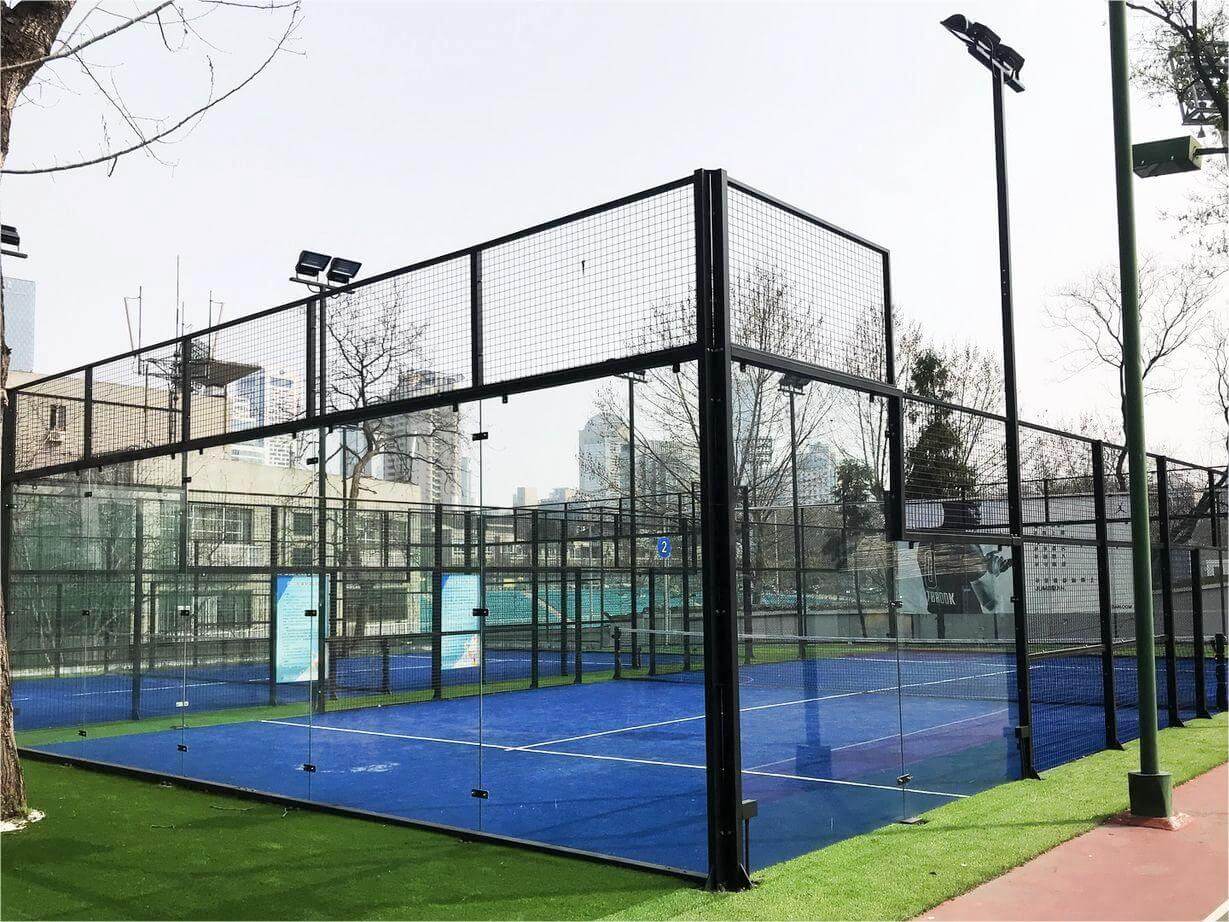
Padel is one of the fastest-growing racket sports in the world, and the surface beneath players’ feet determines everything — ball bounce, player safety, game speed, and how many years the court lasts before needing replacement. A padel court is built from several components: the steel structure, glass panels, lighting, and fencing. But the turf is the one element players interact with on every single point.
Get the turf selection wrong and you are looking at premature fiber wear, inconsistent ball bounce, and costly replacement within two to three years. Get it right, and a well-specified padel surface will hold up under heavy daily use for eight to twelve years.
▼ At a Glance
- Pile height of 10–12 mm is the standard for most padel courts, with 12 mm being the most common
- Fiber thickness (Dtex) should be 8,000 Dtex or higher; for high-traffic facilities, 9,000–13,500 Dtex is recommended
- KDK yarn outperforms standard ATY yarn in resilience and shape retention — 6+ years vs ~3 years
- High-density turf (50,000+ stitches per m²) delivers consistent ball bounce and longer surface life
- Quartz silica sand infill (grain size 0.2–0.8 mm) is the standard fill medium — around 10–15 kg/m² depending on turf type
- Blue is the most common court colour, but green, red, and custom colours are available
Inhoudsopgave
- Pile Height: The Starting Point for Ball Behaviour
- Fiber Thickness (Dtex): The Durability Factor Most Buyers Overlook
- Yarn Type: KDK vs. ATY — Why It Matters for Performance Courts
- Turf Density: More Stitches, Better Performance
- Sand Infill: The Component That Completes the System
- Colour: More Choice Than You Might Expect
- Frequently Asked Questions
- The Right Turf Makes the Court
Pile Height: The Starting Point for Ball Behaviour
The pile height of padel court artificial turf typically falls between 10 mm and 15 mm, with 12 mm being the most common standard. This is significantly shorter than football turf (40–60 mm) because padel gameplay requires a firm, fast, and predictable surface rather than cushioned ground contact.
A lower pile height — around 10 mm — produces a slower ball speed and more stable rebound, which suits beginners or players who prioritise ball control. A higher pile — around 15 mm — speeds up rolling and rebounding, creating a faster-paced experience better suited to intermediate and advanced players.
For most commercial padel facilities, 12 mm is the right choice. It balances playability across all skill levels, holds sand infill well, and maintains consistent surface characteristics as the turf ages.
| Stapelhoogte | Ball Speed | Best For |
|---|---|---|
| 10 mm | Slower, more controlled | Beginners, ball-control focused players |
| 12 mm | Balanced | Most club and commercial courts ✔ |
| 15 mm | Faster, more dynamic | Intermediate to advanced players |
Fiber Thickness (Dtex): The Durability Factor Most Buyers Overlook
Dtex stands for decitex — a unit measuring the weight of yarn per 10,000 metres. The higher the Dtex value, the thicker and heavier the fiber. For padel, fiber thickness is one of the most consequential specifications because the sport places repeated, concentrated stress on a small court surface.
Fiber specifications for padel courts typically range from 8,000 to 10,000 Dtex. The higher the Dtex value, the thicker the fiber, and the stronger the wear resistance and resistance to foot traffic. High-Dtex fibers can better withstand frequent use and high-intensity competitive play.
Thin fibers — anything below 7,000 Dtex — flatten and fray quickly under the lateral sliding movements that define padel. A court receiving heavy daily use with low-Dtex turf may need full surface replacement within one to two years. Investing in higher-Dtex fiber from the start is significantly more economical over the life of the facility.
Arturf recommendation: Our padel turf range runs from 9,000 Dtex to 13,500 Dtex — engineered for high-traffic facilities where surface longevity is non-negotiable.
Yarn Type: KDK vs. ATY — Why It Matters for Performance Courts
Not all curly yarns are equal. Two production methods dominate the padel turf market: ATY (Air Textured Yarn) and KDK (Knit De Knit). Understanding the difference could save you a full court replacement within five years.
What is KDK yarn?
KDK stands for Knit De Knit — a special texturing technique that uses ring knitting and heat setting. The yarn is first knitted into a tube, steam treated to fix the crimps, then unknitted — leaving a yarn with stable, consistent loops throughout. It is made entirely from polyethylene (PE) and can be produced at high Dtex values.
What is ATY yarn?
ATY (Air Textured Yarn) is produced using air streams at low temperatures. It is cheaper to manufacture and widely used in entry-level and recreational padel surfaces. However, ATY yarn retains its shape for approximately three years maximum, after which fibers begin to lose their crimp and the surface gradually flattens.
| Property | KDK Yarn | ATY Yarn |
|---|---|---|
| Production method | Ring knitting + heat setting | Air stream texturing |
| Material | 100% PE | PP/PE blend |
| Shape retention | 6+ years | ~3 years maximum |
| Resilience | Higher — more filled and complete | Lower |
| Ball rebound | Excellent, consistent | Good initially, degrades over time |
| Shock pad needed | Usually not required | Often recommended |
| Best for | Professional and heavy-use facilities | Recreational and budget courts |
For any facility expecting regular daily play — a club, sports centre, or padel venue — KDK yarn is the correct specification. The higher upfront cost is offset by significantly longer surface life and more consistent playing characteristics year after year.
Turf Density: More Stitches, Better Performance
Density refers to the number of fiber tufts per square metre. High-density turf — around 50,000 to 55,000 stitches per square metre — provides better durability, enhanced playability, and a longer lifespan than lower-density alternatives.
Higher density delivers three measurable benefits on a padel court. First, it improves ball bounce consistency — the surface responds the same way regardless of where the ball lands. Second, it holds sand infill more evenly, keeping the court playing at specification for longer between maintenance cycles. Third, it resists flattening in high-traffic zones like the service areas and the central corridor behind the net, where most court wear occurs.
When evaluating turf density from a supplier, ask for stitches per square metre alongside the Dtex value. Both figures together tell you far more about real-world durability than either spec alone.
Sand Infill: The Component That Completes the System
Artificial turf for padel is not complete without the correct sand infill. The sand must be silica-based, free from organic matter, and meet granulometry requirements typically ranging from 0.2 to 0.8 mm for optimal performance. Quartz silica sand is the industry standard.
The sand does several things simultaneously: it stabilises the turf fibers in an upright position, controls ball bounce height and rolling speed, cushions player landings, and allows the controlled sliding movements that are a fundamental part of padel technique.
| Turf Type | Sand Infill Required | Grain Size |
|---|---|---|
| KDK textured turf | ~7–8 kg/m² | 0.2–0.5 mm |
| Fibrillated / monofilament turf | ~15 kg/m² | 0.2–0.8 mm |
Important: Never use construction sand or beach sand. Irregular grain shapes abrade fiber roots and accelerate surface degradation. Only kiln-dried quartz silica sand — clean, round-grain, and consistently graded — is appropriate for padel turf infill.
Colour: More Choice Than You Might Expect
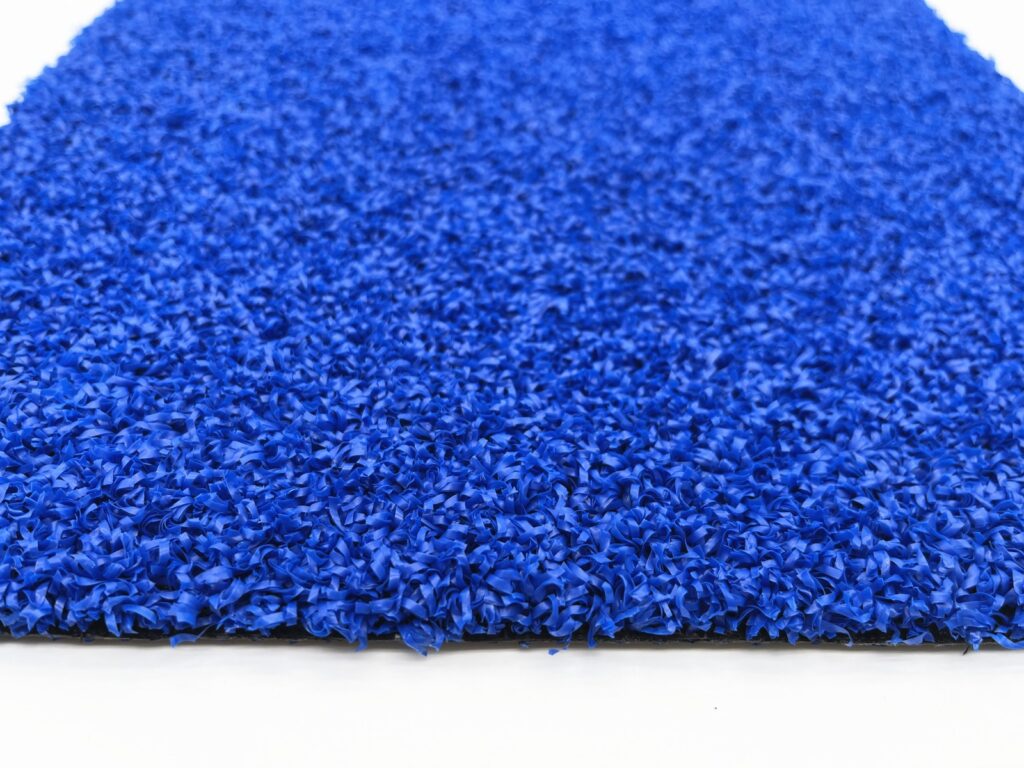
Padel surfaces come in a variety of colours and, according to most governing body guidelines, courts should be single-tone rather than multi-colour. Blue is the dominant choice across professional and club venues worldwide, offering high contrast against the yellow ball and a clean, contemporary appearance that photographs and films well.
Green, terracotta, red, and custom colours are available from most manufacturers. Colour is largely an aesthetic and branding decision — it does not affect playing performance. If your courts will be used for competitive play or tournaments, confirm that your chosen colour meets the requirements of your governing body before ordering.
At Arturf, we offer padel turf in blue, green, red, and other colours on request. Custom colourways are available subject to minimum order quantities.
Frequently Asked Questions
What pile height is best for a padel court?
The standard pile height for padel courts is 10–12 mm, with 12 mm being the most widely used specification. Shorter pile (10 mm) produces a slightly slower, more controlled game, while longer pile (up to 15 mm) creates a faster surface. For most club and commercial facilities, 12 mm delivers the best balance of playability, durability, and maintenance requirements.
What Dtex should padel turf have?
For padel courts expecting regular or heavy use, a minimum of 8,000 Dtex is recommended, with 9,000–13,500 Dtex being the range for professional and high-traffic facilities. Low-Dtex fibers — below 7,000 Dtex — wear out quickly under the lateral movements and repeated ball impact that characterise padel, and may need replacement within one to two years on a busy court.
What is KDK yarn and why does it matter for padel?
KDK (Knit De Knit) yarn is produced through a ring-knitting and heat-setting process that creates more stable, resilient crimped fibers compared to standard ATY (air textured) yarn. KDK yarn retains its shape for six or more years, versus approximately three years for ATY yarn. For padel courts with regular daily use, KDK yarn is the recommended specification — it delivers more consistent ball bounce and significantly longer surface life.
What type of sand should be used to fill a padel court?
Kiln-dried quartz silica sand with a grain size of 0.2–0.5 mm is the correct infill for padel courts. The sand must be free of organic matter and consistently graded. Approximately 7–8 kg/m² is needed for KDK textured turf, and around 15 kg/m² for conventional fibrillated or monofilament surfaces.
How long does padel turf last?
A well-specified padel surface — 8,000+ Dtex fibers, KDK yarn, high density, correct sand infill, and regular maintenance — can last 8 to 12 years under moderate to heavy use. Low-specification turf with thin fibers and poor infill management may need replacement within 2 to 3 years on a busy court.
Does padel turf colour affect performance?
No — colour is a purely aesthetic decision and has no effect on ball bounce, traction, or surface durability. Blue is the most common choice for its high contrast against the yellow ball. Green, red, and custom colours are available. Always confirm colour compliance with your governing body if competition use is planned.
The Right Turf Makes the Court
Choosing padel turf is not a decision to make on price alone. The fiber thickness, yarn type, density, and infill system together determine how the court plays on day one — and how it continues to perform three, five, and ten years later. A surface that looks identical at installation can diverge dramatically in performance and longevity based on specifications that are invisible to the eye.
If you are specifying a padel court — for a club, a sports centre, an investment project, or a residential facility — Arturf’s team can advise on the right turf specification for your usage level, climate, and budget. Neem contact met ons op of view our padel turf range to get started.